

November 2026 North Bay Housing & Real Estate Update

In This Month’s Update
-
Sonoma County: Nearly 4,000 properties just gained potential new ADU flexibility
-
Marin County: Affordability remains strained even as inventory stays tight
-
California housing policy: Proposition 37 could reshape how some middle-income buyers get into the market
-
Mortgage rates: Three straight weeks of declines—but borrowing costs are still high
-
Bay Area regulations: Gas water-heater rules were delayed and softened
-
Insurance: FAIR Plan increases are now showing up in real ownership costs
-
What I’m watching next: October contracts, price reductions, inventory, and whether lower rates actually bring buyers back
There is a lot happening in housing right now that does not fit neatly into a “prices up” or “prices down” headline. In Sonoma County, a zoning change that took effect November 5 could materially expand the usefulness of thousands of rural properties. In Marin, affordability remains one of the biggest constraints in the market even though inventory continues to stay tight. At the state level, voters just approved a potentially significant new homeownership-financing program, while Bay Area regulators backed away from an aggressive timeline for gas water-heater replacements.
And then there are mortgage rates. After climbing sharply through September and October, rates have now moved lower for three consecutive weeks. That is encouraging—but not enough yet to declare an affordability reset. The common thread is that the cost and usefulness of owning a home are increasingly being shaped by much more than the sale price itself.
Sonoma County: Nearly 4,000 Properties Just Gained New ADU Potential
One of the most consequential Sonoma County changes this fall officially took effect on November 5. The county removed the longstanding Z Combining District restriction from approximately 3,997 parcels in unincorporated Sonoma County outside the Coastal Zone. Those properties had previously been subject to a blanket restriction that limited accessory dwelling unit development.
For affected owners, this potentially opens the door to adding an ADU for multigenerational living, long-term rental income, a caregiver, adult children, aging parents, or simply more flexibility in how a property is used. That does not mean 3,997 ADUs are suddenly ready to be built. Water supply, septic capacity, fire-safety requirements, building codes, agricultural restrictions, access, and other property-specific issues can still determine whether a project is feasible. But the removal of the blanket zoning restriction is still important because it changes the starting point.
Why this matters for buyers and sellers
For buyers evaluating rural Sonoma properties, ADU potential may now deserve a fresh look. A property that previously had limited expansion options could become significantly more useful if an additional dwelling is feasible. For sellers, verified ADU potential may become a meaningful marketing advantage—particularly for buyers looking for rental income, multigenerational living, or future flexibility.
The key word is verified. I would not advertise an affected parcel as “ADU approved” simply because the Z restriction has disappeared. Buyers should still investigate the property's actual development constraints before assigning value to that opportunity. And for investors, one distinction is particularly important: permission to build an ADU is not the same as permission to operate it as a short-term vacation rental. Those uses remain governed separately.
Sonoma’s Housing Market: More Balanced, More Selective
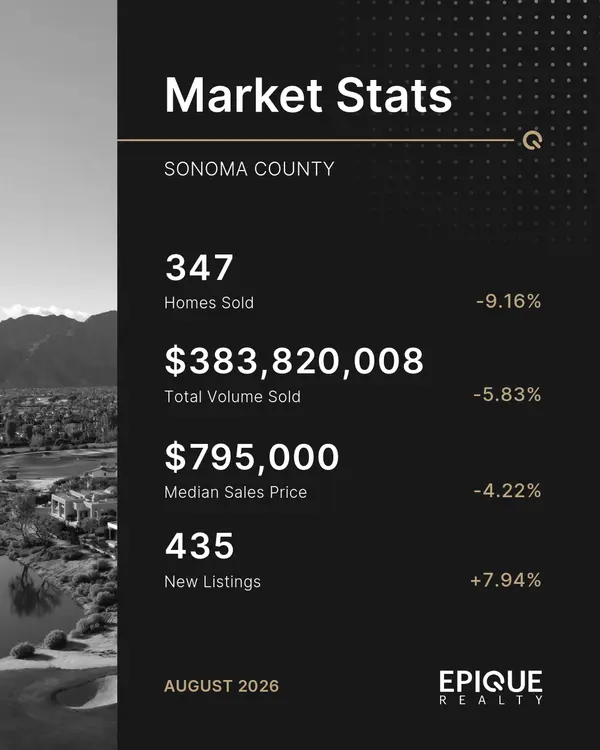
The latest fully comparable county figures remain September. C.A.R. reported a Sonoma County existing single-family median sale price of $875,000, up 10.1% from September 2025, while closed sales declined 3.4% year over year. Months of inventory stood at 4.0, compared with 4.1 a year earlier, and median time to sell improved to 61 days from 76 days.
That combination is more nuanced than the price headline suggests. A 10.1% increase in a monthly median does not mean every Sonoma home appreciated 10%. Monthly medians can move considerably depending on the mix of homes that happened to close, and a separate third-quarter BAREIS-derived analysis showed a much more modest 1.4% increase in the median. That is one reason I would be cautious about extrapolating too much from a single month.
What does seem clear is that Sonoma remains a more balanced and price-sensitive market than Marin. With roughly four months of inventory, buyers have more ability to compare properties, negotiate repairs, and reconsider homes that have accumulated market time. Sellers can still do very well—but pricing and preparation matter.
Where I see opportunity
For buyers, the best opportunities are often not visible in the countywide statistics. They tend to appear in homes that need cosmetic work, have already taken price reductions, carry insurance complexity, or simply launched at the wrong price. For sellers, this is not a market where “testing” a high price is harmless. Buyers have enough choices to move on. That does not mean Sonoma is weak; it means buyers are selective.
Marin County: Tight Inventory, High Prices—and a Serious Affordability Problem
Marin continues to operate under a very different supply dynamic. September C.A.R. data showed a median single-family price of approximately $1.68 million, with closed sales up 11.1% year over year and just 2.2 months of inventory. Quarterly BAREIS-derived data showed the same general direction: stronger sales, fewer listings, faster transactions, and a market where well-positioned properties continue to attract competition.
But this week, the more interesting Marin number is not a sale price. It is $433,200. That is the annual household income C.A.R. estimates was needed in the third quarter to qualify for Marin County’s median-priced single-family home under its standardized assumptions, including a 20% down payment. The estimated monthly principal, interest, taxes, and insurance payment was approximately $10,830, and only about 24% of Marin households were estimated to be able to afford that median-priced home.
The surprising comparison with Sonoma
Sonoma’s estimated qualifying income was much lower—about $212,000—with an estimated monthly PITI of approximately $5,300. Yet Sonoma’s affordability index was slightly worse at 22%. That sounds counterintuitive until you remember that affordability indexes are not simply about home prices; they compare home prices with the income distribution of households living in each county.
Marin has much more expensive housing, but also substantially higher household incomes. That does not make Marin “affordable.” It simply means affordability depends on both sides of the equation.
What this means for the market
Marin’s limited inventory continues to support sellers, but affordability creates a natural ceiling. At some point, even high-income buyers become payment-sensitive. For buyers, that means the countywide shortage does not eliminate negotiating opportunities—especially on homes that have been sitting, reduced, or present condition issues. For sellers, low inventory remains an advantage, but it does not provide unlimited pricing power.
Proposition 37: Could California Make It Easier to Buy With Less Cash?
One of the biggest statewide housing developments this week was the passage of Proposition 37. The measure authorizes up to $25 billion in revenue bonds intended to expand homeownership financing for eligible middle-income Californians. According to the California Association of REALTORS®, the program is designed to help some qualified buyers purchase with approximately 3% down rather than 20%, with mortgage payments ultimately supporting repayment of the bonds.
C.A.R. estimates the program could eventually help hundreds of thousands of households, but implementation is everything. The measure still needs program rules, eligibility standards, lender participation, and final financing mechanics before buyers can actually use it.
Why it could matter in Sonoma
The biggest benefit may be for buyers who can afford a monthly mortgage payment but have difficulty accumulating a large down payment. That is a very real issue in Sonoma, where a 20% down payment on an $800,000 home is $160,000 before closing costs. Reducing the cash hurdle could expand the pool of qualified buyers.
Why Marin may be different
In Marin, the monthly payment remains the larger obstacle. Putting less money down on a $1.7 million house does not solve the problem of qualifying for a very large mortgage. So while Proposition 37 could help some Marin buyers, I would expect its practical impact to be greater in markets where down-payment savings—not monthly income—is the primary barrier.
Mortgage Rates: Three Weeks of Relief, But We’re Not Back to Summer
Mortgage rates finally moved in a favorable direction again. Freddie Mac reported that the average 30-year fixed mortgage fell to 7.18% on November 5, marking the third consecutive weekly decline. That is down from 7.40% on October 15, 7.32% on October 22, and 7.24% on October 29.
The decline is welcome, but context matters. Rates were still just 6.76% on September 10, so although we have recovered part of the October spike, borrowers are still paying materially more than they were two months ago. On an $800,000 mortgage, the difference between 7.40% and 7.18% is roughly $120 per month in principal and interest. Helpful? Yes. Transformative? Not yet.
The question I’m watching
The bigger question is whether lower rates actually bring buyers back. The answer will not show up immediately in closed-sale prices. The first clues should come from pending contracts, new listings, price reductions, and days on market. If pending activity strengthens while inventory remains limited, sellers could regain some leverage. If buyers remain hesitant despite lower rates, then affordability pressures may be more entrenched than rate movements alone can solve.
Gas Water-Heater Rules: The Deadline Just Moved
Another consequential Bay Area housing change came from the Bay Area Air District. Regulators approved revisions to the rules governing replacement of natural-gas water heaters, pushing the first major compliance date back from January 2027 to January 2028. The revised rules also add important exemptions for circumstances involving electrical capacity, ventilation, limited installation space, and qualifying lower-income households, while certain multifamily and deed-restricted affordable properties will receive even longer timelines.
This matters because older homes in both Sonoma and Marin can require substantial electrical upgrades to accommodate a heat-pump water heater. A replacement that sounds simple in theory can become expensive when the electrical panel, wiring, space, or ventilation system also needs modification. The new timeline provides breathing room and also makes the rules more property-specific than the original version suggested.
Most importantly, this is generally about what happens when equipment is replaced, not a mandate forcing every owner to immediately remove a functioning gas water heater. For buyers evaluating older homes, the issue should still be part of future maintenance planning. For sellers, the delay reduces the immediate likelihood that an ordinary water-heater replacement becomes a surprise retrofit expense during the coming year.
Insurance: The FAIR Plan Increase Is Now Real
California’s FAIR Plan residential dwelling-fire increase began taking effect October 15. The statewide approved average increase is 29.1%, but that number should not be treated as a universal increase. Individual policies can move very differently depending on the property, location, coverage, and wildfire exposure.
For North Bay homeowners, the important point is that insurance is increasingly becoming part of the property-value conversation. A home’s affordability is no longer simply purchase price + mortgage + taxes. Increasingly, it is purchase price + mortgage + taxes + insurance + property-specific risk.
That distinction is especially relevant in rural Sonoma and hillside areas of Marin. For buyers, I would investigate insurance earlier than ever. For sellers, documentation of defensible space, roof condition, wildfire-hardening improvements, prior claims, and current coverage can help reduce uncertainty. And for investors, insurance belongs in the underwriting spreadsheet—not as an afterthought once a property is already under contract.
What I’m Watching Next
The next round of data should be particularly revealing because we will finally begin seeing transactions that were negotiated during October’s higher-rate environment.
Sonoma
I am watching October pending sales, new listings, price reductions, whether four months of inventory begins climbing, and how buyers respond to newly eligible ADU properties. If rates continue falling while inventory remains available, we could see a more active buyer market without immediately producing major price appreciation.
Marin
The biggest question is whether severely limited inventory continues to offset affordability pressure. If Marin listings remain scarce and rates continue easing, desirable properties could see renewed competition very quickly. But if inventory begins to rise at the same time high borrowing costs keep buyers cautious, the market could become more negotiable.
Both counties
I am increasingly watching total ownership cost, not simply price. Mortgage rates, insurance, infrastructure, energy rules, and development flexibility are becoming significant parts of the value equation, particularly when comparing properties that look similar on paper but carry very different operating costs or future possibilities.
What Should You Do With This Information?
If you are thinking about buying, this is a good time to get more specific rather than simply waiting for “the market” to improve. Have your lender rerun your numbers at current rates, investigate insurance before you fall in love with a property, and pay particular attention to listings that have accumulated days on market or already reduced their price. In Sonoma, buyers considering rural properties should also revisit ADU potential—the rules may have changed since the last time a property was evaluated.
If you are thinking about selling, start with your competition rather than a countywide median. Look at what buyers can purchase at the same price today, how long comparable homes are taking to sell, and where reductions are happening. It may also be worth addressing questions about insurance, defensible space, major systems, and potential ADU use before the home reaches the market so buyers have fewer reasons to hesitate.
If you already own a home, there are several things worth checking even if you have no plans to move. Review your insurance renewal carefully, confirm whether your property is one of the Sonoma parcels affected by the ADU zoning change, and factor the revised water-heater timeline into future maintenance planning rather than waiting until equipment fails.
And if you are investing, I would underwrite conservatively. Use today's financing costs rather than assuming rates will fall, update insurance expenses with actual quotes, and verify rental or ADU assumptions before assigning value to them. In this market, a property's operational details can make the difference between a good opportunity and an expensive mistake.
Thinking About Buying, Selling, or Investing in Sonoma or Marin?
Market conditions can look very different from one neighborhood—or even one property—to the next. If you are considering a move, wondering what your home could realistically sell for, or evaluating an investment opportunity, I’m happy to help you look beyond the countywide headlines and work through the numbers that actually apply to your situation.
Jory Bergman Killian, REALTOR®
Epique Realty
Wine Country to Waterfront
Finding opportunities. Designing value.
CA DRE #02283148
My Take
The North Bay is entering an interesting phase. Sonoma remains the more balanced market and probably offers buyers more opportunities to negotiate at the individual-property level, while Marin remains supply constrained but faces an extraordinary cost-of-ownership ceiling. At the same time, regulatory and policy changes are becoming increasingly important.
Nearly 4,000 Sonoma parcels may now have greater ADU potential. California voters have approved a potentially significant homeownership-financing program. Bay Area regulators have delayed an expensive building-equipment deadline. Insurance costs are rising, and mortgage rates are finally drifting lower. None of these changes alone determines where home prices go next, but together they shape the environment in which buyers decide what they can afford—and sellers decide what their property is worth.
The most important numbers in the next market update will not simply be median prices. I’ll be watching contracts, inventory, price reductions, and whether buyers actually respond to improving mortgage rates.
Sources
California Association of REALTORS® — September 2026 county housing statistics and Q3 Housing Affordability Index
Freddie Mac — Primary Mortgage Market Survey
Sonoma County — ADU zoning changes affecting the former Z Combining District
California Association of REALTORS® — Proposition 37 election announcement
Bay Area Air District — amended water-heater appliance regulations
California Department of Insurance / California FAIR Plan — residential dwelling-fire rate changes
Market statistics are intended to describe broad market conditions. Monthly and quarterly medians can be affected by the mix of homes sold and should not be interpreted as a direct change in the value of every property.
Categories
Recent Posts






GET MORE INFORMATION

Jory Bergman Killian
Agent License ID: 02283148