

August 2026 Sonoma & Marin Housing Market Update
In This Month’s Update
- Sonoma County: Are buyers starting to gain ground?
- Marin County: Is this market strength broader than just low inventory?
- Mortgage rates: Is meaningful relief finally coming?
- Insurance: What the FAIR Plan increase could mean for North Bay homeowners
- West Marin housing: Why 54 new affordable homes matter more than the number suggests
- Homelessness prevention: Why keeping people housed is becoming a bigger policy priority
- What buyers and sellers should watch heading into fall
August’s single-family data show two distinctly different market stories in Sonoma and Marin counties. Sonoma is showing signs of a more selective environment: fewer homes sold, the median price moved lower, and more listings came to market, even as homes sold faster and price per square foot increased. Marin moved in the opposite direction, with stronger sales, higher prices, faster marketing times, and homes closing above list price.
Those contrasts raise more interesting questions than the headline numbers alone can answer. Is Sonoma becoming more buyer-friendly, or are we simply seeing a change in the mix of homes that sold? In Marin, is low inventory still the main driver, or are we seeing broader buyer demand? And across both counties, how much will mortgage rates, insurance costs, and housing policy shape the fall market?
Sonoma County: Are Buyers Starting to Gain Ground?
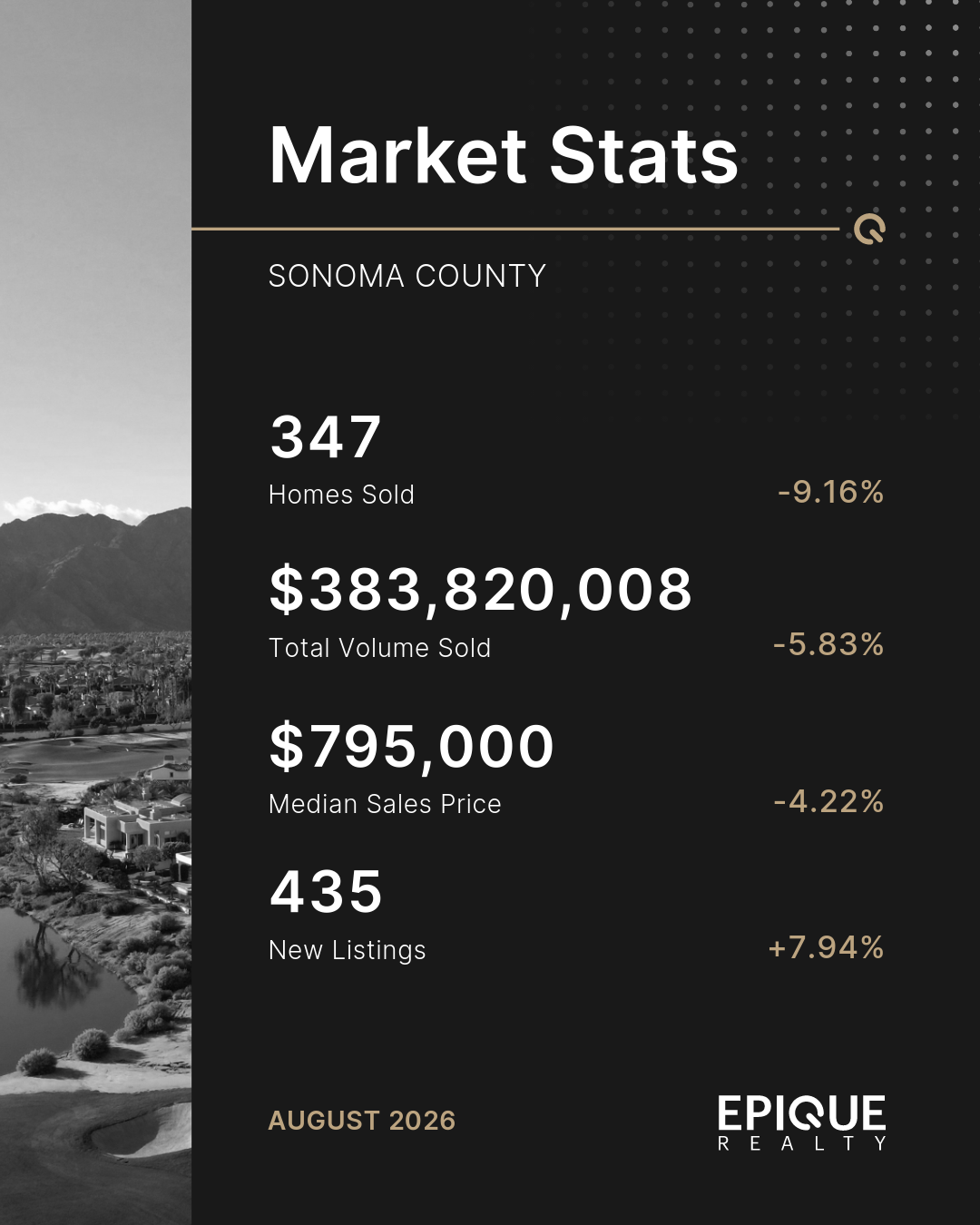
August single-family statistics show a softer market on the surface. A total of 347 homes sold, down 9.2% from the comparison period, while the median sale price fell 4.2% to $795,000. At the same time, new listings increased 7.9% to 435, average days on market fell 21.4% to 49 days, price per square foot increased 2.4% to $552, and the average sale price rose 3.7% to approximately $1.106 million. The sale-price-to-list-price ratio was 100%, while total sales volume declined 5.8% to approximately $383.8 million.
If the median fell, why did price per square foot rise?
This is exactly why monthly median prices require context. The median tells us the midpoint of the homes that happened to close during a particular period; it does not mean that every Sonoma County property lost 4.2% of its value. In August, the median moved lower while both the average sale price and price per square foot moved higher, which suggests the mix of homes sold likely played an important role.
For example, if more modestly priced homes transact in one month, the county median can decline even if comparable properties are not broadly losing value. That is why I would describe Sonoma as softening and increasingly negotiable, rather than simply saying prices are falling.
The number I’m watching: more listings, fewer sales
This may be the most consequential Sonoma signal heading into fall. New listings increased nearly 8% while closed sales declined more than 9%, which means supply is moving in one direction while completed demand is moving in the other. If that continues through September and October, buyers could gain additional negotiating leverage.
One month does not make a trend, though. The next question is whether those new listings actually accumulate into higher inventory or whether buyers absorb them as fall activity picks up. That distinction will matter much more than any single monthly median.
What this means for Sonoma sellers
Pricing matters enormously right now. Buyers appear willing to purchase good homes, and the 100% sale-price-to-list-price ratio supports that, but they are much less forgiving of homes that start too high. A seller who prices correctly from day one may still perform very well, while a seller who “tests the market” may discover that the first few weeks of exposure are difficult to recover once buyers have mentally moved on.
What this means for Sonoma buyers
This is where I see opportunity. Not necessarily because the entire county is suddenly inexpensive, but because a slower, more selective market creates property-level leverage. Homes that need cosmetic work, have accumulated days on market, already reduced their price, or present insurance or renovation complexity may offer better opportunities than the headline median suggests.
Marin County: Is This More Than Just Low Inventory?
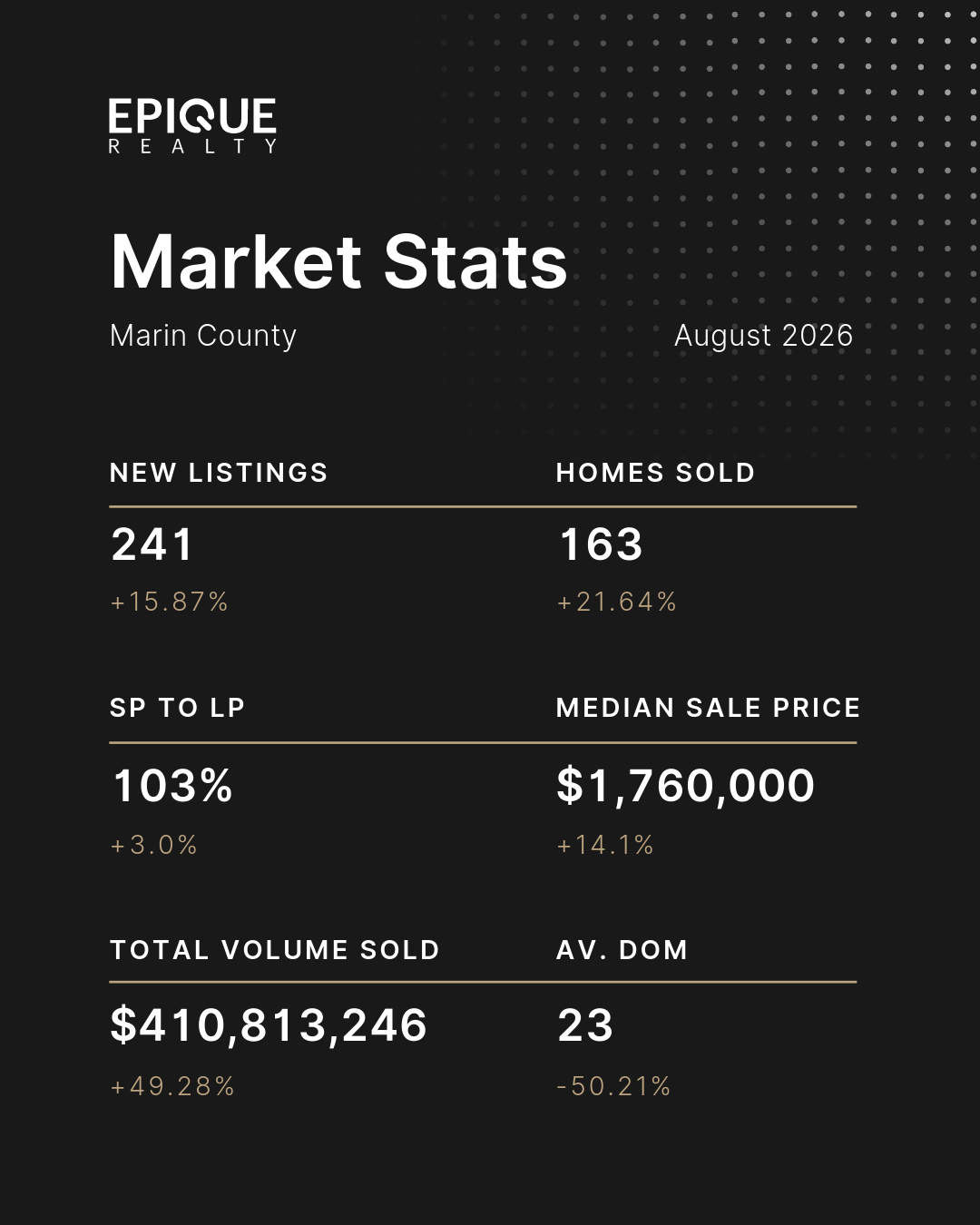
Marin’s August numbers are difficult to ignore. A total of 163 homes sold, up 21.6%, while the median sale price rose 14.1% to $1.76 million. The average sale price increased 22.7% to approximately $2.52 million, average days on market fell 50.2% to just 23 days, new listings increased 15.9% to 241, and price per square foot rose 14.8% to $1,007. The sale-price-to-list-price ratio reached 103%, while total sales volume increased 49.3% to approximately $410.8 million.
This is not simply one volatile median-price number. Multiple measures are moving together, and that matters.
When median price and price per square foot both rise about 14%, what does that tell us?
It gives us considerably more confidence that Marin is experiencing genuine pricing pressure. Median sale price increased 14.1%, price per square foot increased 14.8%, homes sold more than 20% more frequently than a year earlier, and average marketing time was cut roughly in half. That is a much more convincing picture of market strength than a median-price spike alone.
The average sale price increase of 22.7% deserves more caution because Marin’s high-end transactions can significantly distort an average. Even so, the broader pattern is striking because the median, price per square foot, transaction volume, and speed of sale are all moving in the same direction.
And homes sold for 103% of list price
That means August single-family sales averaged roughly 3% over asking price. Countywide averages do not mean every Marin house received multiple offers, but combined with a 23-day average market time, they indicate that desirable properties are attracting meaningful competition.
Is this still just an inventory story?
Low inventory is absolutely part of Marin’s strength, but the August numbers suggest there may be more going on than scarcity alone. When price, price per square foot, sales volume, and speed of sale all improve together, that is a broader sign of buyer demand.
The question I am watching next is whether this strength can continue as affordability becomes more challenging, especially if mortgage rates remain elevated. Marin may be less rate-sensitive than many markets, but it is not immune to the impact of financing costs on large loan balances.
Mortgage Rates: The Relief Buyers Wanted Hasn’t Arrived
Mortgage rates are still one of the biggest forces shaping the North Bay housing market. Freddie Mac reported that the average 30-year fixed mortgage reached 6.76% on September 10, up from 6.71% the week before and 6.66% on August 27. The 15-year rate averaged 6.09%.
Source: Freddie Mac Primary Mortgage Market Survey
That may not look like a dramatic change, but on North Bay loan balances, small rate movements matter. In Sonoma, monthly payment affordability can directly affect purchasing power. Marin has more high-equity and cash buyers, but borrowers taking large jumbo loans are hardly immune.
The question I’m watching
Do rates finally move meaningfully lower this fall, or does the market have to continue adjusting to financing near 7%? Until we see sustained improvement, affordability remains a major constraint.
Insurance: The FAIR Plan Increase Is Getting Closer
Insurance remains one of the most consequential and underappreciated housing issues in Sonoma and Marin. California FAIR Plan residential rates are scheduled to increase by an average of 29.1% beginning October 15, 2026, although the actual increase will vary significantly by property. Homes in higher wildfire-risk areas can face much larger increases, while some lower-risk properties may see smaller changes.
Source: KQED reporting on California FAIR Plan rate changes
For homeowners in rural Sonoma, hillside Marin, and other wildfire-exposed areas, this can directly affect the economics of ownership. It can also affect a sale before anyone reaches the closing table because a property that looks affordable based purely on mortgage payment and taxes may look very different after insurance is added.
Insurance is becoming part of the real estate negotiation
Buyers should be investigating insurance much earlier in the process, and sellers should consider understanding their home’s insurance situation before listing. Insurability is increasingly relevant to marketability, and I expect that to become even more important as buyers pay closer attention to total monthly carrying costs.
West Marin Housing: Why 54 Affordable Homes Matter More Than the Number Suggests
There was also a genuinely consequential housing development in Marin this month. On September 9, Marin County announced that the former Coast Guard housing site in Point Reyes Station received low-income housing tax credits expected to generate approximately $27 million in equity, clearing the way for construction to begin in early 2027.
The project, known as Tamalko Homes, is being developed by Eden Housing and the Community Land Trust Association of West Marin. It will create 54 affordable homes — the largest housing development in West Marin — with some units reserved for agricultural workers and retirees from agricultural work. The project will serve households earning no more than 60% of area median income, with some homes targeted to households at 30% of area median income.
Will 54 units lower Marin home prices?
No, not in any meaningful countywide sense. Marin’s housing shortage is far too large for 54 units to materially alter the overall for-sale market, but that does not make the project unimportant. West Marin depends heavily on agricultural, hospitality, school, service, and tourism workers who increasingly struggle to live anywhere near the communities where they work.
Housing those workers locally can help stabilize the labor force, reduce displacement, and preserve community continuity. That is a very different economic function from simply “adding supply.”
Homelessness: Prevention Is Becoming Part of Housing Policy
Marin is also shifting more attention toward preventing homelessness before it occurs. Its new Keep People Housed Marin program is a two-year pilot providing targeted financial assistance and housing-stabilization services to residents who are still housed but at serious risk of losing their homes.
Source: Marin County Health and Human Services
The timing matters. Marin’s 2026 Point-in-Time Count found 1,128 people experiencing homelessness, up modestly from 1,090 in 2024. About 74% were unsheltered, and 88% of surveyed individuals said they lived in Marin before becoming homeless. Economic hardship was the most commonly cited cause.
Source: Marin County 2026 Point-in-Time Count
Why does prevention matter?
That last point is important because homelessness in Marin is not simply an issue imported from elsewhere; most people counted were already Marin residents. From a housing-policy standpoint, helping someone remain housed can be substantially less disruptive — and often less expensive — than trying to rehouse someone after they become homeless.
This will not change Marin’s home prices, but it may be an important part of keeping the county economically functional for people outside the luxury housing market.
So What Should Buyers and Sellers Be Watching Now?
For Sonoma, I am watching whether the increase in new listings continues while sales remain soft. If inventory begins to accumulate, buyers may gain additional leverage heading into fall. If listing activity slows again, prices may remain more resilient than the decline in sales volume would otherwise suggest.
For Marin, I am watching whether this combination of higher prices, faster sales, and stronger transaction volume continues. At some point, rising prices can begin to create their own affordability ceiling, even in a high-income market. I am also watching whether Marin’s increase in new listings continues; August brought more new listings than a year ago, which is healthy, but demand is still absorbing homes quickly.
Across both counties, mortgage rates and insurance remain the two outside variables most likely to change buyer behavior quickly.
My Take Heading Into Fall
Sonoma County is increasingly selective and potentially becoming more favorable to buyers, but it is not showing signs of broad distress. Marin County is unusually strong, fast-moving, and competitive, with multiple indicators confirming genuine pricing pressure. Mortgage rates continue to restrict affordability, insurance is becoming a larger part of the buying and selling equation, and housing policy is becoming more closely tied to workforce stability, homelessness prevention, and the long-term health of North Bay communities.
The most important takeaway is that each county is moving through a very different phase of the market, and the opportunities for buyers and sellers are increasingly property-specific.
Thinking About Buying, Selling, or Investing?
If you are thinking about buying, selling, or investing in Sonoma or Marin County and want to understand how these trends apply to a specific property or neighborhood, feel free to reach out.
Jory Bergman Killian, Realtor®
Wine Country to Waterfront
Sonoma + Marin Counties
DRE #02283148
Market statistics shown above are August 2026 single-family residence MLS data supplied in the accompanying market reports. Percentage changes reflect the comparison period shown in those reports. Monthly medians and averages can be influenced by the mix of homes sold and should not be interpreted as a direct change in the value of every property. Mortgage-rate, insurance, housing-policy, and homelessness figures are drawn from the cited public sources.
Categories
Recent Posts






GET MORE INFORMATION