

House Hacking: How to Turn the Home You Live In Into an Investment
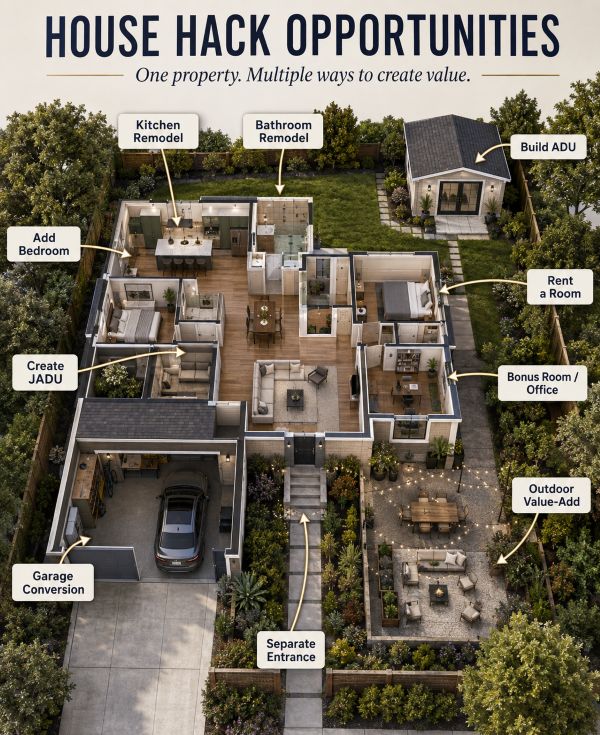
What if your next home could also be your first real estate investment?
For many people, real estate investing sounds like something that comes after buying a home: save more money, build more equity, then someday purchase a rental property.
But there’s another way to think about it.
What if the home you buy today could help create the financial capacity to buy the next one?
That’s the idea behind house hacking—and it can involve much more than buying a duplex or getting a roommate.
CLICK HERE: GET THE FREE HOUSE HACKING GUIDE
Learn how to spot income potential, forced-equity opportunities, ADUs, value-add renovations and multiple exit strategies before you buy.
What Is House Hacking?
At its simplest, house hacking means buying a property you’ll live in while intentionally looking for ways that property can improve your financial position.
There are two big opportunities I look for: creating income and creating equity.
Income might come from renting another unit, an ADU or bedrooms within the home. Equity may come from buying a property with unrealized potential and improving it through renovations, a better floor plan, additional permitted living space, an ADU or other value-creating improvements.
Sometimes the best house hack does both.
House Hacking Through Income
Imagine buying a duplex, living in one unit and renting the other. Or purchasing a single-family home with an existing ADU that can generate monthly rental income.
You could also consider a property with bedrooms appropriate for roommates or, depending on the property and local regulations, an opportunity to create additional rentable space.
The goal isn't necessarily to eliminate your housing payment. Even partially offsetting the cost of homeownership can change the economics significantly while you're simultaneously building equity in an asset you own.
House Hacking Through Equity
This is the part of house hacking that I think is often overlooked.
The property doesn't necessarily have to produce rental income on Day One to be an interesting investment opportunity.
Perhaps the kitchen and bathrooms are dated. Maybe there's poorly utilized square footage, an awkward floor plan, an unfinished area with potential, or enough property to investigate adding an ADU.
Instead of asking only, “Do I like this house?”, we start asking:
What could this property become?
Thoughtful improvements may increase a property's utility, desirability and potentially its market value. Investors sometimes call this forcing appreciation: rather than relying solely on the market to increase your equity over time, you're looking for opportunities to actively create value.
Of course, not every renovation creates a dollar-for-dollar increase in value, and additions, conversions and ADUs require careful investigation of zoning, permits, construction costs and market demand.
That's where evaluating the property before you buy becomes so important.
How I Look for a House-Hack Property
When I'm helping a client evaluate this type of opportunity, I'm not necessarily searching for the prettiest house on the market.
I'm looking for possibility.
Could the floor plan work differently? Is there underutilized space? Could another bedroom or bathroom materially change the property? Is there an existing ADU—or somewhere an ADU might potentially be feasible? Could improvements increase both the property's value and its income-producing potential?
Then we start investigating what is actually possible.
That may mean researching zoning and permit history, analyzing comparable properties, estimating potential rental income and resale value, and bringing in appropriate contractors, lenders or other professionals when we need expertise outside the Realtor's role.
This is one reason an outdated or slightly unusual property can sometimes be more interesting to an investor than the beautifully remodeled house next door.
Your Exit Strategy Starts Before You Buy
Another concept I want new investors to understand is exit strategy.
An exit strategy simply answers: What are my options later?
Perhaps you live in the property for several years and eventually move out while keeping it as a rental. Maybe you refinance after creating additional equity. You might use that equity toward another investment, or eventually sell the property.
There isn't necessarily one correct answer. In fact, I generally find a property more interesting when there are multiple potential paths to success.
Life changes. Markets change. Interest rates change.
Having options matters.
The Acquisition Strategy Comes First
This is why I don't begin an investment-property search simply by asking, “How much house can you afford?”
First I want to understand what we're trying to accomplish.
Are we trying to reduce your monthly housing expense? Create rental income? Build equity through improvements? Add another unit? Hold the property long term? Eventually convert the entire property to a rental?
Once we know the strategy, we can create a Buy Box and start searching for properties that actually fit it.
And that search doesn't have to be limited to the obvious choices. A great opportunity might be a duplex, a fixer, a house with an ADU, an unusual floor plan, a property with expansion potential—or even a perfectly ordinary-looking home that has possibilities other buyers have overlooked.
Could Your Next Home Be a House Hack?
If you're thinking about buying a home in Sonoma or Marin County, you don't have to wait until someday to start thinking like a real estate investor.
Before you eliminate the fixer, the duplex, the house with the funky extra space or the property with an oversized lot, let's look at what it could become.
I help clients evaluate properties through both a homebuyer's and an investor's lens—looking at potential income, improvements, equity opportunities and possible exit strategies before deciding whether an opportunity is worth pursuing.
Have a property you've been looking at? Send it to me. I'd be happy to show you what I see.
For buyers considering short-term rentals as another real estate investment strategy, I’ve also put together a guide to evaluating whether you can operate a vacation rental in Sonoma County.
Jory Bergman Killian
REALTOR® | Epique Realty
DRE #02283148
Wine Country to Waterfront | Sonoma & Marin
Categories
Recent Posts





GET MORE INFORMATION